The French Scarf: How to Tie a Scarf the French Way
The French way with a scarf: the Parisian knot, light foulards, simple colors and a relaxed attitude — and how men can borrow it.
Ask anyone to picture a Frenchman in winter and there is probably a scarf in the picture — knotted a little loosely, never fussy, worn as if it took ten seconds. That is the whole idea: the French scarf is less a product than a way of wearing one. Learning to tie a scarf the French way comes down to one knot, a few fabric choices and a relaxed attitude.
This guide covers what gives a scarf that Parisian look, how to tie the Parisian knot and its variations, how to wear a light foulard in warmer months, which scarves work best and the outfits and mistakes to know about.
What makes a French scarf look French?
- The knot: the Parisian knot (fold in half, loop, pull through) — compact, warm and neat.
- The fabric: fine wool or cashmere in winter, a light silk or cotton foulard in spring.
- The colors: navy, gray, camel, burgundy — one color at a time.
- The attitude: slightly undone. Tie it, adjust once, leave it.
None of this is a rulebook. It is a style often associated with Paris: understated pieces, good fabric and a scarf that looks lived-in rather than arranged.
Écharpe vs foulard
In French, a warm winter scarf is une écharpe and a light scarf is un foulard — the English word for foulard is simply a light (often silk) scarf. More in scarf in French and what is a foulard.
How to tie the Parisian knot
- Fold the scarf in half lengthwise: a loop at one end, tails at the other.
- Put it around your neck with the loop on one side.
- Pull both tails through the loop and slide it up to tighten.
- Fold the scarf in half lengthwise so you have a loop at one end and two tails at the other.
- Place it around the back of your neck with the loop on one side and the tails on the other.
- Reach through the loop and pull both tails through it.
- Slide the loop gently up toward your neck until it closes the gap at your collar, without pulling it tight.
Tip: leave the loop slightly loose and pull one tail a little longer than the other. Perfect symmetry looks stiff.
Variations on the French knot
- The loose Parisian: leave the loop low on the chest for a relaxed look on milder days.
- The twisted loop: pull one tail through, give the loop a half twist, then pass the second tail through the new opening. It holds more firmly in wind.
- The tucked Parisian: tie the knot, then tuck both tails inside a buttoned coat for a flat, warm finish under tailoring.
Want to see the knot form? Try it on a virtual mannequin in the Scarf Studio.
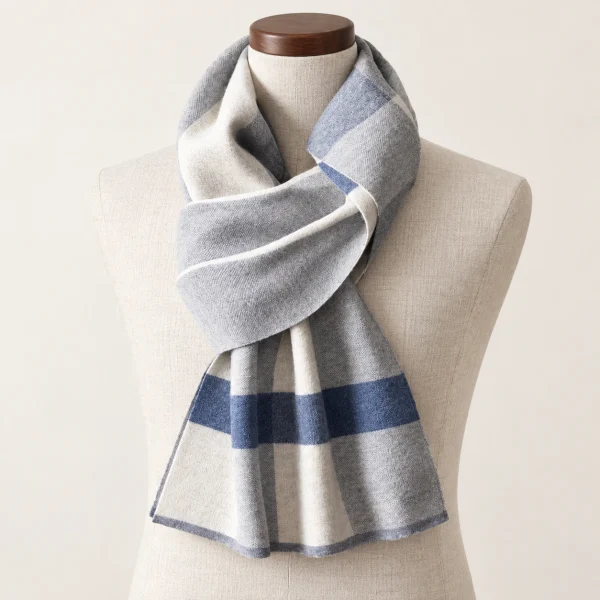
Choosing a scarf for the French look
- Length: the Parisian knot folds the scarf in half first, so it needs enough length to leave tails after folding. Around 70 inches is a comfortable starting point; see our men’s scarf length guide.
- Weight: medium or fine. Very chunky knits make the knot bulky.
- Fiber: fine merino and cashmere fold neatly and drape softly. Our cashmere scarf guide explains what to look for.
- Pattern: solids, subtle stripes or a quiet herringbone. Bold novelty prints work against the understated look.
The French way with a foulard
- Lay a square scarf flat.
- Fold it into a triangle, then roll it into a band.
- Tie it around your neck with a small knot at the side.
In spring and summer, the foulard takes over: a small square of silk or cotton tied at the neck with an open collar.
- Fold the square into a triangle, then roll it from the long edge into a narrow band.
- Wrap it around your neck under the collar.
- Tie a small knot slightly off-center and tuck the ends inside the shirt, or let them sit flat.
Keep the knot small and the print modest. For more on tying small squares, see our neck scarf guide.
The French scarf through the seasons
- Winter: a fine wool or cashmere écharpe in a Parisian knot, tucked into a buttoned overcoat on the coldest days.
- Early spring: a lighter wool or wool-silk scarf, knotted loosely and worn with a trench coat.
- Late spring and summer: a silk or cotton foulard at an open collar, or a long light cotton scarf draped over a T-shirt on cool evenings.
- Fall: the return of the écharpe, often in camel, burgundy or forest green, worn once around or in a loose Parisian knot.
The common thread is that the scarf is worn almost all year, adapted to the weather rather than packed away.
Colors for a French-style scarf
The classic palette is quiet: navy, charcoal, mid-gray, camel, cream and burgundy, with the occasional faded red or forest green. The idea is to choose one color that lifts the outfit rather than several that compete. A gray scarf with a navy coat or a navy scarf with a camel coat is about as French-looking as it gets. For more combinations, see what color scarf should a man wear.
Outfits
- Navy overcoat, gray scarf, white shirt — the Paris office look.
- Camel coat, navy scarf, dark jeans — the weekend version.
- Linen shirt, small silk foulard, rolled sleeves — summer.
- Navy peacoat, striped Breton top, cream wool scarf in a loose Parisian knot — a nautical classic.
- Beige trench coat, gray crew-neck sweater, burgundy fine wool scarf — spring and fall.
- Black leather jacket, white T-shirt, charcoal cashmere scarf — evenings.
Caring for a French-style scarf
A scarf worn most of the year needs a little attention to keep that easy look. Air wool and cashmere between wears, brush off lint, and follow each label for washing rather than guessing from the fiber name. Untie silk foulards after wearing so creases do not set.
How to look effortless (it takes a little practice)
The French approach looks casual, but it rests on a few habits. Tie the knot once and adjust it once, not five times. Let the scarf sit a little uneven. Wear it with simple, well-fitting clothes so it does not have to carry the outfit. And practice the knot at home until your hands know it, because ease comes from repetition, not from fussing in front of a mirror.
Common mistakes
- Pulling the loop tight: it should close the collar gap, not grip your neck.
- Perfect symmetry: even ends and a centered knot look stiff.
- Too thick a scarf: a bulky knit turns the knot into a lump.
- Matching sets: a scarf, hat and gloves in the same pattern look less relaxed than mixed tones.
- Too many accessories: let the scarf be the main detail.
For other knots that suit different coats and weather, read our full guide on how to wear a scarf for men.
FAQ
What is a French knot for a scarf?
Usually the Parisian knot: the scarf folded in half, placed around the neck and the tails pulled through the loop.
What is a foulard in English?
A light scarf, often silk — also the name of a silk fabric with small printed patterns.
Do French men wear scarves in summer?
Light scarves are a common warm-weather accessory in the French-style look — usually a small foulard with an open collar.
Is the Parisian knot warm?
Yes. Because the loop closes around the collar, it blocks wind better than an open drape, while staying less bulky than a twice-around.
Should the scarf go inside or outside the coat?
Both are typical. Outside, with the knot showing, is the classic look on an open coat; inside, with the tails tucked, is warmer under a buttoned overcoat.
Can I tie a French knot with a short scarf?
It is harder, because folding the scarf in half leaves short tails. With a shorter scarf, try a loose once-around instead.
Scarves for the Parisian knot
71 × 12 in · finished edges · free tracked US shipping · 30-day returns
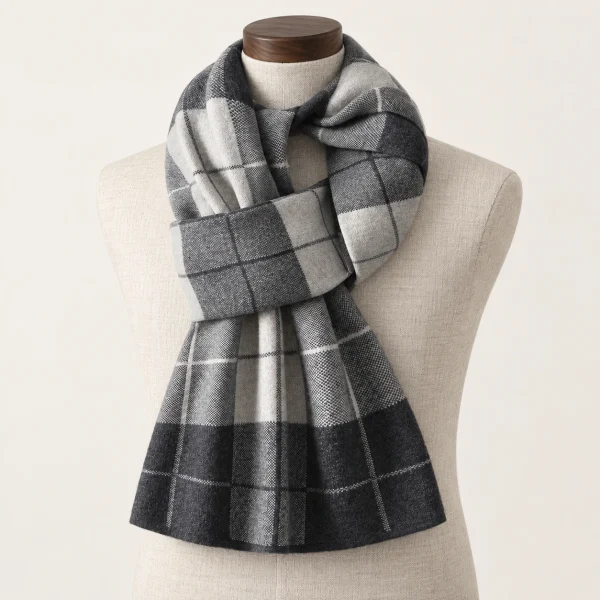 Light Gray Windowpane Reversible Wool Scarf$69.90Add to cart
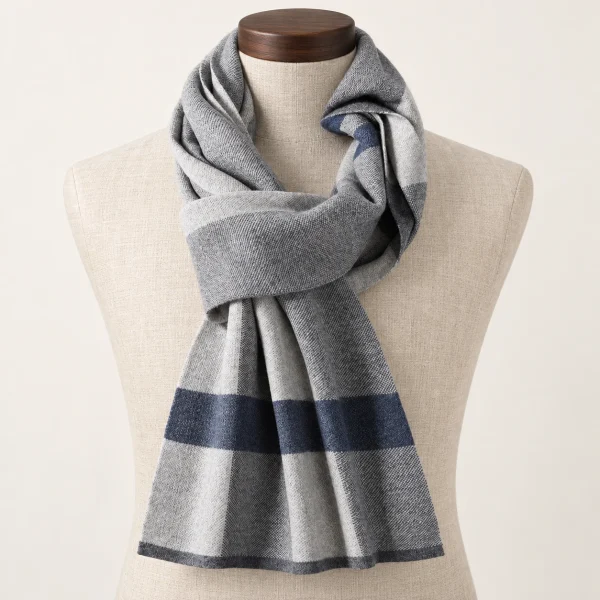 Ash Gray & Blue Stripe Wool-Blend Scarf$64.90Add to cart
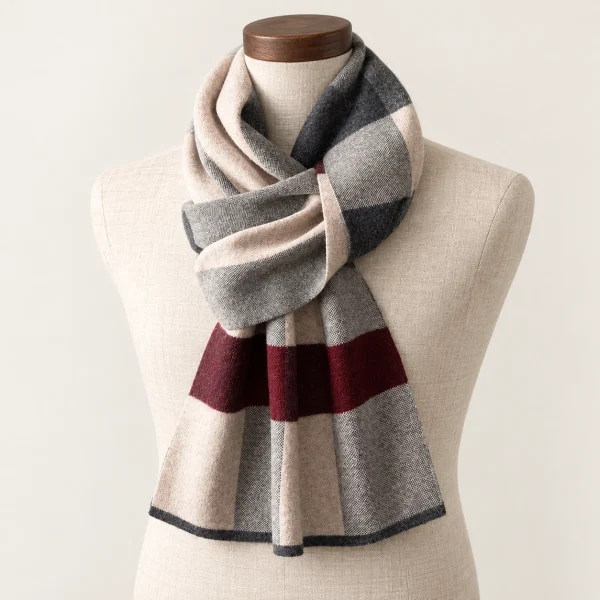 Beige & Burgundy Stripe Reversible Wool Scarf$69.90Add to cart
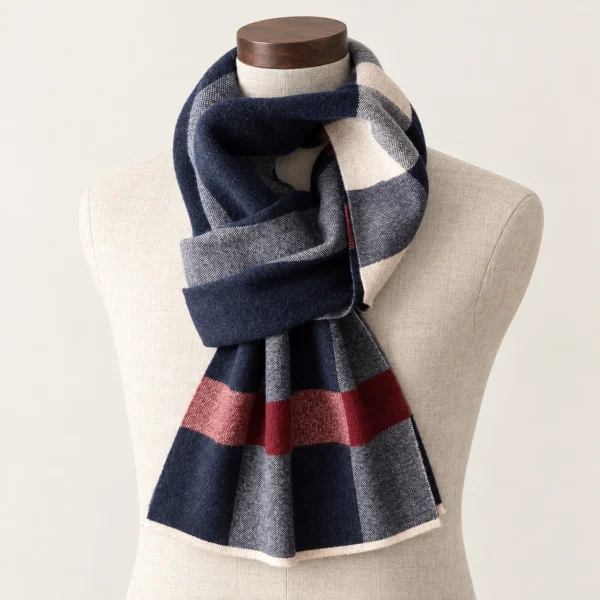 Navy & Rose Stripe Reversible Wool Scarf$69.90Add to cart