How Silk Is Made: From Silkworm to Scarf
A simple guide to how silk is made — from silkworm cocoons to woven, printed silk scarves — and what it means for quality.
Silk is the only major natural textile fiber produced as a continuous filament — and how silk is made explains why a good silk scarf feels the way it does. Here is the journey from silkworm to scarf, step by step, along with what each stage means for the scarf you buy and wear.
Silk production began in ancient China, where the techniques were closely guarded for centuries. The trade routes that later linked China with Central Asia and Europe became known as the Silk Road. Today, China and India are the largest silk producers.
1. How silk is made starts with sericulture: raising silkworms
Most silk comes from the domesticated silkworm (Bombyx mori), which feeds on mulberry leaves. Raising silkworms for silk is called sericulture. After several weeks of eating, each caterpillar spins a cocoon from a single long protein filament.
The silkworm’s life cycle runs from egg to caterpillar to pupa to moth. During the caterpillar stage it eats almost constantly and molts several times as it grows. When it is ready, it spins its cocoon over a few days, producing the filament from glands in its head and winding it around itself in a figure-eight motion. Domesticated silkworms depend entirely on human care; they have been bred over thousands of years and cannot survive in the wild.
2. Stifling and sorting the cocoons
If the moth were allowed to emerge, it would break through the cocoon and cut the long filament into short pieces. In conventional silk production, the cocoons are therefore heated or steamed before that happens, a step known as stifling. A small number of moths are allowed to emerge to lay eggs for the next generation. The cocoons are then sorted by size, color and quality.
3. How silk is made into thread: reeling the filament
The cocoons are softened in hot water so the filament can be unwound. A single cocoon can yield several hundred meters of filament. Several filaments are reeled together into one thread.
Because one filament is far too fine to use alone, reelers combine the filaments from several cocoons at once and twist them lightly as they wind. The result is raw silk thread. Long, unbroken reeled silk is what gives the smoothest, most lustrous fabrics.
Spun silk and noil
Not all silk is reeled. Broken cocoons, the outer and inner layers that cannot be reeled, and cocoons from which moths have emerged are processed differently. Their shorter fibers are combed and spun like wool or cotton, producing spun silk, which is softer and less shiny. The shortest leftover fibers become silk noil, a matte, slightly nubby yarn with a casual look.
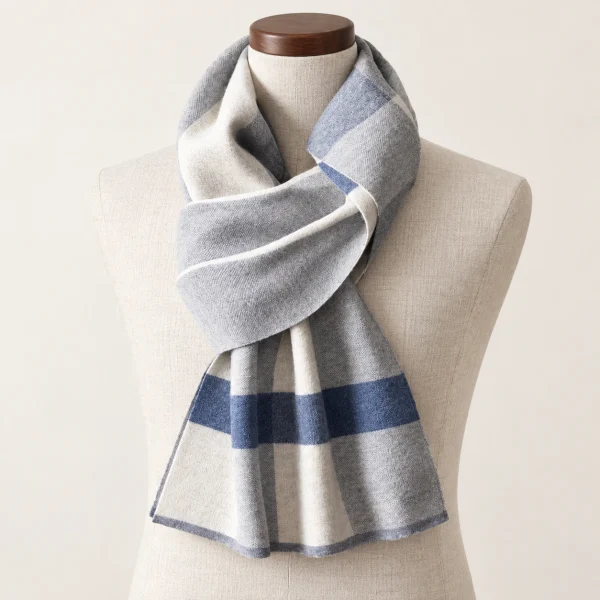
4. Degumming
Raw silk is coated in a natural gum called sericin. Washing it away (degumming) reveals silk’s soft hand and luster.
The fiber left behind is mostly fibroin, a strong protein. Its smooth surface and the way it reflects light are what give silk its characteristic sheen. Degumming can be done on the yarn or on the woven fabric.
5. Weaving
| Weave | Character | In scarves |
|---|---|---|
| Twill | Diagonal weave, holds a knot | Classic men’s scarves and ties |
| Satin / charmeuse | High shine on one side | Evening scarves |
| Habotai | Light, plain weave | Lightweight scarves, linings |
| Crepe de chine | Matte, slightly grainy | Soft drape, prints |
| Jacquard | Patterns woven into the cloth | Tone-on-tone dress scarves |
“Foulard” describes a light silk, often twill, printed with small repeating patterns — see what is a foulard.
Silk fabric weight is often given in momme, a traditional unit. A higher momme means a heavier, denser fabric that usually drapes more fully and wears longer.
6. Dyeing and printing
Silk takes dye beautifully, which is why silk prints look so vivid. Patterns can be printed by screen or digitally.
- Yarn dyeing: the thread is dyed before weaving, used for woven patterns and solid colors.
- Piece dyeing: the finished fabric is dyed in one color.
- Screen printing: each color is applied through its own screen, so complex designs take many steps.
- Digital printing: the design is printed directly from a file, allowing fine detail and many colors.
On a printed silk scarf, the color usually shows through to the back but looks lighter there. That is normal and a sign that the dye has penetrated the fabric.
7. Finishing
A well-made silk scarf has hand-rolled or neatly machine-rolled hems, even color and no puckering at the edges.
A hand-rolled hem is plump and slightly irregular, with small stitches you can see up close. A machine-rolled hem is flatter and more uniform. Both can be good; what matters is that the edge is even and secure. Our guide to designer scarves for men explains other quality signs worth checking.
Other kinds of silk
- Wild (tussah) silk: from wild silk moths; more textured and golden.
- Peace (ahimsa) silk: produced so the moth emerges from the cocoon before processing.
Because the moth breaks the filament, peace silk is spun rather than reeled, so it tends to look softer and less shiny than conventional reeled silk.
Telling silk from imitations
Polyester and other synthetics can be made to look a lot like silk, especially satin weaves. A few checks help:
- Read the label: look for “100% silk” or “mulberry silk,” not vague terms such as “silky” or “silk feel.”
- Look at the sheen: real silk often has a soft, shifting luster that changes with the light, while many synthetics have a flatter, more uniform shine.
- Feel the hand: good silk feels smooth and supple and warms quickly in your hand.
- Check the back of a print: on printed silk, the design usually shows through lighter on the reverse.
None of these is foolproof on its own, so the fiber label remains the most reliable guide.
What this means for your silk scarf
- Luster: long reeled filaments give the smoothest, shiniest fabric; spun silk and noil look softer and more matte.
- Strength: silk is strong for its weight, but it can be weakened by sunlight, perspiration and harsh detergents.
- Warmth: a thin silk scarf adds little warmth in winter; it is mainly for style. See best scarf material for winter for warmer fibers.
- Care: follow the label; many silk scarves are dry clean or gentle hand wash only. Store them clean and loosely folded or rolled, as explained in how to store scarves.
From fabric to your collar: wearing a silk scarf
- Lay a square scarf flat.
- Fold it into a triangle, then roll it into a band.
- Tie it around your neck with a small knot at the side.
A small silk twill square is ideal for a neckerchief, because it holds a knot without slipping. Fold it into a triangle, roll it into a band and tie a small knot at the side. Our neck scarf guide covers more ways to tie it.
FAQ
Why is silk expensive?
Raising silkworms and reeling the filament take a lot of time and care.
What is the best silk for a men’s scarf?
Twill silk: it is durable, holds a knot and prints well.
What is mulberry silk?
Silk from the domesticated Bombyx mori silkworm, which is fed on mulberry leaves. It is the most common type of silk.
Is silk a protein fiber?
Yes. Like wool, silk is made of protein, which is why harsh alkaline detergents and bleach can damage it.
Is silk warm?
Thin silk adds little warmth on its own. It is comfortable in a wide range of temperatures, but for real cold choose wool or cashmere.
Learn how to wear a silk scarf.
We sell wool scarves: the closest picks for this look
71 × 12 in · finished edges · free tracked US shipping · 30-day returns
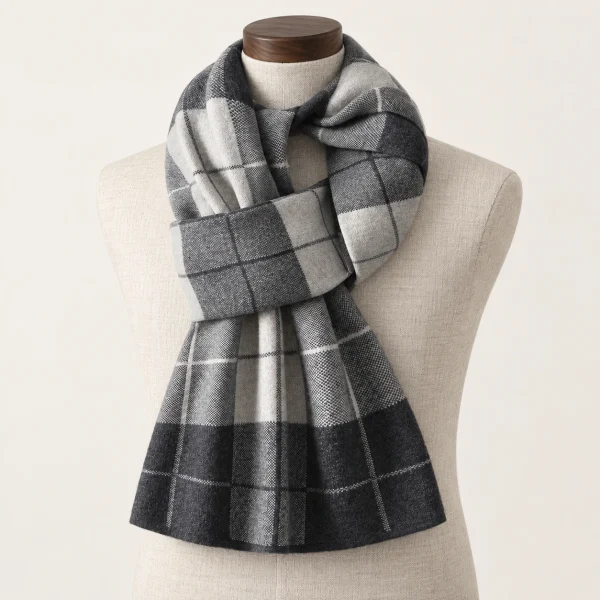 Light Gray Windowpane Reversible Wool Scarf$69.90Add to cart
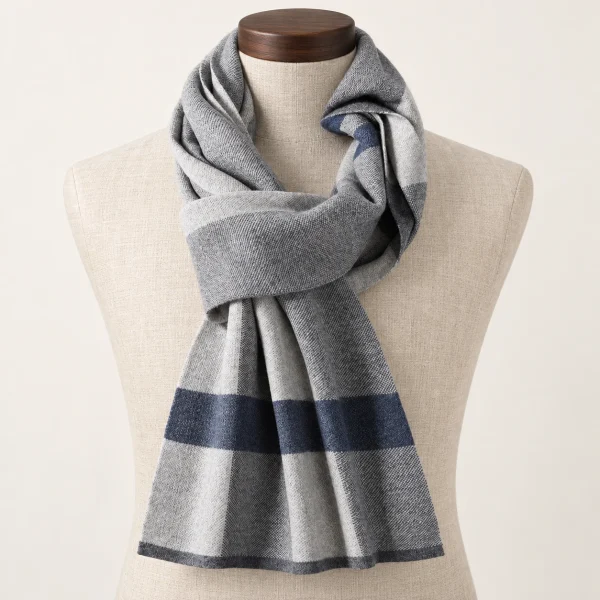 Ash Gray & Blue Stripe Wool-Blend Scarf$64.90Add to cart
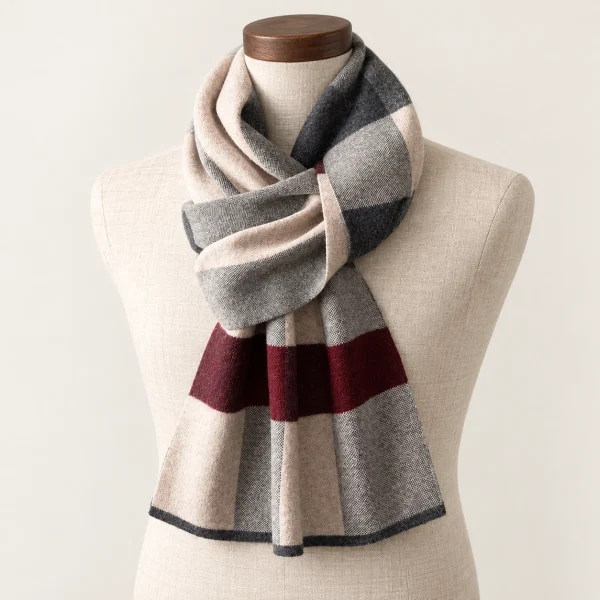 Beige & Burgundy Stripe Reversible Wool Scarf$69.90Add to cart
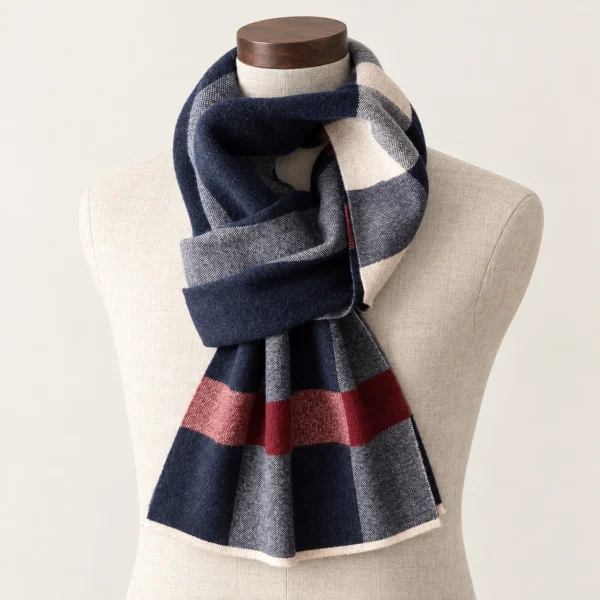 Navy & Rose Stripe Reversible Wool Scarf$69.90Add to cart